STORIES
Italy’s Farming
Influencers
They’re young, they farm, they post. A new wave of women is turning Italian agriculture into a social phenomenon — running tractors, businesses, and feeds that mix tradition with fresh rural style.
Italy
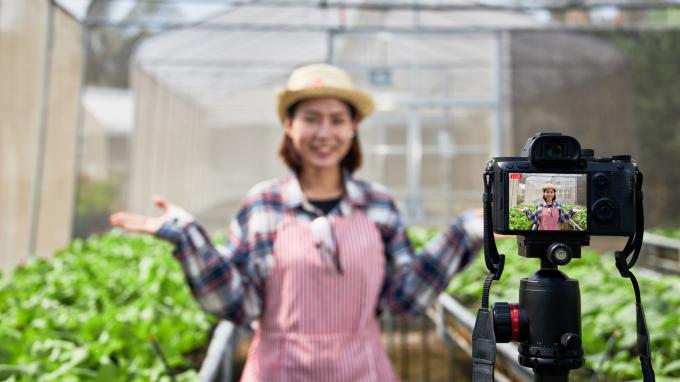
There are corners of the Mediterranean that are once again speaking the language of the land. Young women, agronomists, and food artisans are rewriting the relationship between agriculture, communication, and identity, demonstrating that sowing and posting their activities on Instagram or other social media can become complementary gestures. They are the new agri-influencers, a definition that may sound frivolous but which, in their case, captures the essence of a silent revolution: describing work in the fields not as a relic of the past, but as a frontier of the future.
In the Veneto countryside, Giulia Tonello - 26, a graduate in agricultural sciences with over forty thousand followers on Instagram- drives a tractor like a natural extension of herself. In her stories, the mud, the sowing, the fifteen-hour shifts become part of a daily routine, portrayed unfiltered. "As a child, I preferred agricultural machinery to dolls," she said in an interview: a phrase that alone sums up the symbolic reversal her generation brings with it.
"As a child, I preferred agricultural machinery to dolls"
Tonello, like others, doesn't use social media to aestheticize the countryside, but to reclaim the dignity of a profession still too closely associated with masculinity and the past. Hers is an agriculture that communicates itself: technical, physical, concrete, yet aware of the narrative power of images.
Further south, in Campania, Maria Pezone grows tomatoes, melons, and lettuce in Giugliano, close to Naples, on her family farm. She calls herself an "agricultural influencer," and she does so without irony. In her videos, she shows the cycles of the land, the greenhouses, the harvest phases, as well as logistics and market decisions. Her communication breaks the cliché of the young woman "posing among the rows": Pezone gets her hands dirty, discussing techniques, margins, and prices. Her story is that of a generation struggling to balance tradition and innovation, production and visibility. In a South often portrayed as backward, her digital voice is a political act: demonstrating that agriculture there too is a laboratory for the future, not a relic.
Maria Pezone calls herself an "agricultural influencer"
Then there are experiences that begin on the farm and become a collective narrative. Like the Janas Farm in Porano, near Orvieto (Umbria), where Eleonora Satta and Ivan Parisi grow ancient grains and organic legumes. Janas is not just a production facility, but a cultural project: the two farmers open their doors to the public, organize farmers' markets, and transform the relationship with consumers into a direct dialogue. Here too, communication is an integral part of the agricultural process: not promotion, but education. Through their social media accounts and on-site activities, the short supply chain becomes a practice of citizenship.
Last but not least, there’s Lucia Cuffaro, a food educator and activist who has been teaching self-production and waste reduction for years. Her blog "Autoproduciamo" and her television programs have anticipated, in a different form, the same need that drives Tonello and Pezone: to reclaim the act of production, restoring it to the dimension of storytelling. Cuffaro is an atypical agri-influencer, more urban and political, but her work - including shared gardens, fermentations, and natural cosmetics - is part of that same constellation that seeks to reconnect consumption to the land.
Lucia Cuffaro's blog turns the act of production back into storytelling
Taken together, these figures paint a feminine and Mediterranean map of the new agriculture. From the industrial North to the rural South, all the way to the opposite shores of the sea, a growing generation of women is using the internet to restore meaning to the word "roots." It's not just a story of sustainability, but a renegotiation of work and identity: being a farmer today also means knowing how to communicate, managing a digital community, explaining one's production choices, and engaging with consumers.
At a time when the land risks disappearing from our imagination—or surviving only as an aesthetic—these women bring it back to the forefront, with languages that blend rigor and lightness, technique and irony. They are not testimonials, but interpreters of a new rural alphabet, in which the tractor and the smartphone do not contradict each other, but complement each other. Perhaps, if we look closely, the Mediterranean of the future will not only be a place of trafficking and crisis, but also a laboratory of agricultural storytelling, where women not only cultivate, but also narrate the land as a common good to be reclaimed.